Showing posts with label urban outfitters. Show all posts

Friday, October 7, 2011

Anthropologie "Haida Poncho"--is Haida the new Navajo?

A couple of weeks ago, I drew attention to how obsessed Urban Outfitters is with the term "Navajo" to represent a catch-all stereotypical southwest/plains asthetic. Then this week, reader Julia sent me a link to the Anthropologie website, with several "Native" inspired pieces. The one that caught my eye was the "Haida Poncho," shown above.

I just thought it was interesting, given we recently discussed Miss Canada's horrific "Homage to Haida," that Haida keeps popping up, rather than the typical Navajo or Cherokee.

First of all, this poncho is made by Pendleton, but is part of their "Portland Collection"--the hipster cool line that I've written about before. I went to both the Pendleton site and the Portland Collection site, and couldn't find anything with the name "Haida."


After the Urban post, a few readers pointed out to me that the products were not named "Navajo" on the original brands' sites, meaning Urban had added the name on later.  Pendleton is generally pretty accurate with their descriptions, linking them to the correct tribe or community where the design originated, so I was surprised that they would call this southwest mess a "Haida" poncho. It makes sense that it may have been a branding choice by Anthro.

Oh, did I mention Anthro and Urban (as well as Free People) are all under the same parent company? Cause they are. Surprise, surprise.

So, if you were wondering what a Haida poncho would look like, here's an example, made by the incredible Dorthy Grant, a Haida designer:


A little different, right? Here is where we pause and talk about how harmful this is to smash completely different cultural groups into one stereotyped "Native American Design." This erases out existence as  diverse, living, and contemporary communities, and furthers the stereotype that there is only one type of "Indian"--the plains warrior that died out long long ago.

But you know what I thought of instantly when I saw the poncho? Wednesday Addams in the Thanksgiving Pageant:

Side-by-side comparison?


Look, I made Wednesday a new outfit!


UPDATE 10/11: A commenter pointed out that the website has changed the name from "Haida Poncho" to "Ashcreek Poncho"! Though some other third party sites are still calling it "Haida." A definite step in the right direction, and pretty awesome if we had anything to do with it!

Links:
Anthropologie "Haida Poncho" (only $248!)
Dorothy Grant, Haida designer

Earlier:
Oh, (Miss) Canada
Urban Outfitters is Obsessed with Navajos
Let's Talk About Pendleton

(Thanks Julia!)

Friday, September 23, 2011

Urban Outfitters is Obsessed with Navajos


A search for "Cherokee" on the Urban Outfitters website reveals 1 result. A search for "Tribal": 15. A search for "Native": 10. "Indian": 2. But Navajo? 24 products have Navajo in the name alone.

This post started as a massive Urban Outfitters take-down, I spent an hour or so last week scrolling through the pages of the website, and adding anything to my cart that was "Native inspired" or had a tribal name in the description. I got through JUST the women's clothes and accessories (no mens or apartment), and had 58 items in my cart. So, then, like any good researcher, I began to code my cart for emergent themes, and the one that jumped out far above the rest? Urban Outfitters is obsessed with Navajos.

I want to show you some examples, and then talk a little about the issues with using tribal names in products that are decidedly not-<insert whatever tribal name here>. Finally, I want to share what the Navajo Nation in particular is doing about it, and the action they've taken is pretty cool.

Without further ado, some of the "Navajo" products to grace the pages of Urban:

From the basic:


To the totally random:

The Antiquated:

And, finally, the totally offensive:


Of course, there are many more if you head over to the site and search "Navajo".

So what's inherently wrong with using Navajo in product names? And what can tribal nations do about it?

First of all, these products represent a stereotype of "southwest" Native cultures. The designs are loosely based on Navajo rug designs (maybe?) or Pendleton designs, but aren't representations that are chosen by the tribe or truly representative of Navajo culture. Associating a sovereign Nation of hundreds of thousands of people witl a flask or women's underwear isn't exactly honoring. 

Additionally, it's more than likely that Urban chose "Navajo" for the international recognition--to most of the world Navajo (and Cherokee)= American Indian  (my Jamaican friend didn't even know there were other tribes in the US until she met me). This conflation of Navajo with "generic Indian" contributes to the further erasure of the distinct tribes and cultures in the US and solidifies the idea that there is only one "Native" culture, represented by plains feathers and southwest designs.

Navajo has taken a bold step, and actually holds trademarks for 12 derivatives of "Navajo", three of which I'm citing below:
 2061748: NAVAJO Sportswear; namely, slacks, shorts, skirts and jeans.

2237848: NAVAJO Clothing; namely, tops, vests, shirts, sport shorts, polo shirts, golf shirts, * jackets, * T-shirts and sweat shirts.

3602907: NAVAJO  Online retail store services; namely, on-line ordering services in the field of clothing—specifically, men's and women's sportswear, namely, jeans, tops, shirts, sport shorts, polo shirts, golf shirts, T-shirts and sweatshirts.
I'm no law expert, but it feels like the products above might be violating the trademarks? 

A few months ago, they Navajo Nation Attorney General actually sent a cease and desist letter to Urban Outfitters, and there are some great quotes from the letter (I'll try and post it in full in another post):
Your corporation’s use of Navajo will cause confusion inthe market and society concerning the source or origin of your corporation’sproducts. Consumers will incorrectly believe that the Nation has licensed,approved, or authorized your corporation’s use of the Navajo name andtrademarks for its products - when the Nation has not - or that yourcorporation’s use of Navajo is an extension of the Nation’s family oftrademarks - which it is not.  Thisis bound to cause confusion, mistake, or deception with respect to the sourceor origin of your goods. This undermines thecharacter and uniqueness of the Nation’s long-standing distinctive Navajo nameand trademarks, which—because of its false connection with the Nation—dilutesand tarnishes the name and trademarks. Accordingly, please immediately cease and desist using the Navajo nameand trademark with your products. 
As a Nation with a distinguished legacy and unmistakablecontemporary presence, the Nation is committed to retaining this distinctionand preventing inaccuracy and confusion in society and the market  The Nation must maintaindistinctiveness and clarity of valid association with its government, itsinstitutions, its entities, its people, and their products in commerce.When an entityattempts to falsely associate its products with the Nation and its products,the Nation does not regard this as benign or trivial.  TheNationremains firmly committed to the cancellation of all marks that attempt tofalsely associate with the institution, its entities, its people or itsproducts. Accordingly, immediately cease and desist using Navajo withyour products.
I haven't heard what the response was from Urban, if any, but I think it is a bold and positive choice for the tribe to take matters into their own hands and push back on instances of misrepresentation and cultural appropriation.

What do you think? Should tribes go the route of Navajo and trademark their tribal names? Do you think this will be an avenue for positive change or just mean tribal courts will be mired in lawsuits, taking away time from other important tribal business?

(Thanks Marj, Brian, and Aza!)

Friday, June 10, 2011

Uh-oh, I just shopped at Urban Outfitters

I'm really hating Urban Outfitters right now. Their endorsement of the "tribal" trend is seriously out of control, and seems to only be getting worse. So today I stopped in to the store near my office to check out for myself what all of my friends had been emailing me about. And it was bad. Bad enough that I will most definitely be doing a long post about them very soon.

But then, I went down to the bargain basement, and I saw the BEAUTIFUL Pendleton blanket above. Gorgeous, right? and guess what?

...it was only $40. Amazing!

So I happily marched up to the checkout counter and bought it. Then I started to feel guilty that maybe I was buying into the horrible Urban Outfitters empire and am now part of the problem. But it's a real Pendleton Blanket!

I'm conflicted. What do you think? Clearly I have mixed feelings about the Pendleton trends, but I also love the blankets and think Pendleton has a good relationship with Indian Country.

EDIT: I should have added a little more context. I just threw this up here quickly because I wanted to show that I'm not infallible when it comes to these issues, and I get confused and conflicted all the time too. I don't make it a habit to shop at UO, definitely don't support their politics, and find them pretty vile overall. I saw the blanket, got super excited by the price, and bought it. Had I stood there and thought about it more, maybe I wouldn't have. But I posted it to just make a quick point about how even for me, who blogs about this stuff day after day, I don't have a perfect set of rules to follow.

As a couple of commenters pointed out (quite humorously--thanks Scott), I guess in a backwards way I did "save" the blanket from someone who wouldn't appreciate it for the right reasons. Maybe? (or just let me think that so I feel better?)

It made me think about how when I was in undergrad, the assistant director of the Native program at Stanford used to keep a box of random memorabilia sporting the Stanford "Indian" mascot from pre-1971. They were things she had found at thrift shops, garage sales, etc., and her whole philosophy was that she would buy it so somebody else wouldn't. I contributed a shirt to the box that I found at at thrift store in San Diego--even paying $14.99 for it, way overpriced for an old tshirt--because I couldn't bear the thought of somebody buying it and wearing it because it was "cool" and "vintage." Is that the same thing as this blanket? No, but thought it might have some relevance here. ha.

Thanks for bearing with me as we figure this out together. :)


Earlier:
Let's Talk About Pendleton
It starts with a trip to Urban Outfitters (my very first post ever!)

Thursday, February 3, 2011

Let's Talk About Pendleton

(look from Pendleton's new "Portland Collection" for Fall 2011. Source here.)

Last night I was cold. So cold, in fact, that I had to pull out not one, but two, of my Pendleton blankets to add some extra warmth to my bed. As I shook them out and laid them on my bed, I thought about how special these blankets are to me--one was a graduation gift, the other a thank you gift for serving on a panel about the "Future of Indian Education." In many Native communities, Pendleton blankets are associated with important events, and have been for hundreds of years. They are given as gifts at graduations, at powwow give-aways, as thank you gifts, in commemoration of births and deaths, you name it. In addition, I've always associated the patterns with Native pride--a way for Natives to showcase their heritage in their home decor, coats, purses, etc. There's something just distinctly Native about Pendleton to me.

(Stanford Native Graduation from a couple years ago)

But recently, Pendleton prints and fabrics have started popping up everywhere. It started with Opening Ceremony's Pendleton line in 2010, and now Urban Outfitters has started carrying a Pendelton line, celebrities are wearing Pendleton coats, and Native-themed home decor is apparently all the rage. Now Pendleton has announced their newest collaboration, The Portland Collection, which fashion blogs are proclaiming will be the big thing for 2011.


So what's the problem? I openly admit that a lot of these designs are adorable, and I would fully sport them (that bag! I love!), if I had a spare $1000 or so. I can't cry straight up cultural appropriation, because...well, it's complicated.

Pendelton has been supplying Natives with blankets and robes with Indian designs since the late 1800's, which the "history" section of their website outlines:
A study of the color and design preferences of local and Southwest Native Americans resulted in vivid colors and intricate patterns. Trade expanded from the Nez Perce nation near Pendleton to the Navajo, Hopi and Zuni nations. These Pendleton blankets were used as basic wearing apparel and as a standard of value for trading and credit among Native Americans. The blankets also became prized for ceremonial use.
It's almost a symbiotic relationship--they saw a market in Native communities, and Native communities stepped up and bought, traded, and sold the blankets, incorporating them into "traditional" cultural activities. Pendleton has also maintained close ties with Native communities and causes, making commemorative blankets for organizations like the National Museum of the American Indian and the National Indian Education Association. They work with Native artists to design the special edition blankets, and even donate some of the proceeds to the causes.

 (NIEA 40th anniversary blanket)

But then, on the other hand, they go off and do things like design a $5000 blanket with White Buffalo hair, which many tribes consider extremely sacred and definitely off-limits to commercial sale.

I do appreciate Pendleton's relationship with Native communities. I love my blankets, and love even more what they represent.
 
However, seeing hipsters march down the street in Pendleton clothes, seeing these bloggers ooh and ahh over how "cute" these designs are, and seeing non-Native models all wrapped up in Pendleton blankets makes me upset. It's a complicated feeling, because I feel ownership over these designs as a Native person, but on a rational level I realize that they aren't necessarily ours to claim. To me, it just feels like one more thing non-Natives can take from us--like our land, our moccasins, our headdresses, our beading, our religions, our names, our cultures weren't enough? you gotta go and take Pendleton designs too?

 (source)
Then there's the whole economic stratification issue of it too, these designs are expensive. The new Portland collection ranges from $48 for a tie to over $700 for a coat, the Opening Ceremony collection was equally, if not more, costly. It almost feels like rubbing salt in the wound, when poverty is rampant in many Native communities, to say "oh we designed this collection based on your culture, but you can't even afford it!"

So I don't know. Are all of these designs cultural appropriation? Should I ignore the twinge in my stomach every time I see a Pendleton pattern in the Urban Outfitters window? Should I embrace it as the mainstream fashion scene finally catching up with what we Natives have known since the 1800's?

Personally, the bottom line is that I would rather associate Pendleton with Native pride and commemorating important events...

(our panel last year)

...than with hipsters, high fashion, and flash-in-the-pan trends. But I'm obviously conflicted. What do you think? Are these designs and trends ok, or do I have a right to be upset?

(Thanks to Precious for getting me thinking about this!)

Tuesday, September 21, 2010

Daily Encounters and Activist Fatigue: The Girl with the Headdress Shirt


Yesterday morning I walked into my 7:15 am "Total Body Workout" class at the gym, laughing and joking with my friend. As I turned to get my hand weights and mat, my gaze fell upon a girl in the class...wearing this shirt.

I sighed and wrinkled my nose, but turned back to my friend to continue our conversation. A few minutes before class started, my friend whispered "Did you see her shirt?! Wasn't that on your blog?" I nodded in response.

As class went on, in between sweating through sit ups and lunges, I kept catching her reflection in the mirror behind me. Each time sent a twinge through my stomach, a quick moment of discomfort and unease. I wanted to say something. I wanted to tell her how I was feeling. But the problem was, even in rehearsals in my head, I couldn't think of how to go about talking to her about the shirt.

 In the grand scheme of images on this blog, this particular shirt isn't that bad. I mean, I can easily sit here and tear it apart--how it represents a stereotype, how the cartoon-izing (I think I just made that word up) of the headdress takes away from it's sacredness and power, commodifying it and making it into a mass consumer good, how the blank, empty space where a head/face should be is representative of decontextualizing the headdress and separating it from the people and places where it belongs...but anyway, it's not an image of an Indian holding aloft a beer bong, or a severed Indian head, or any number of other blatantly racist images. She wasn't wearing a headdress. She was wearing a shirt that she probably bought at Urban Outfitters without a second thought.

But, as I've talked about so many times before, these seemingly benign images have just as much power to create and perpetuate negative stereotypes as the blatantly racist ones. Because of all these images she's seen and encountered in her life, she probably never would have thought that the dark haired girl struggling with push ups in front of her was a Native person who might take offense to her shirt.

So, you're probably wondering, what did I say? What did I do?

Nothing. Absolutely nothing.

Even I, who day after day on this blog can spout the reasons why continued cultural appropriation and misrepresentations of our communities are wrong and harmful, couldn't find the right words to tell an undergrad why her shirt is hurtful to me. 

Not that I'm always silent. I once made a Harvard student in an Indian costume at a local pizza place almost cry when I confronted him, and another time at a football tailgate I physically ripped a headdress off a huge guy's head and stomped on it in the mud, after he wouldn't take it off when I asked nicely (That technique is NOT recommended).

But it's often the daily encounters, the seemingly minor interactions, images, and subtle messages that give me pause. Do I call out every classmate that substitutes the word "powwow" for "meeting"? Do I rip down every indie band poster advertising their latest gig with an image of an Indian? Do I tell the girl in the headdress shirt at my gym class that her shirt hurts me?

Some days I do, some days I don't--or I can't, or I won't--it's a combination. Because this work gets tiring. It's a never ending battle, and some days I'm too tired to fight.

My friend's solution? She thinks I should make up business cards with my blog address on it, so I can just hand one to the offender and say something like "I think you should check out this blog, it might give you a reason to rethink your shirt choice."

So I'm curious--since I don't purport to have all the answers, I'll turn it over to you, readers. Do you have any techniques for dealing with these daily interactions? Do you have a way of approaching someone that cuts defensiveness and allows for your voice to be heard? Stories of encounters with hipster headdresses?

I do have a few techniques I fall back on, but I think it's time we have a step-by-step "how to" guide for dealing with these incidents. So let's generate some thoughts, and I'll compile it all together.

Next time, Girl with the Headdress Shirt, I'll be ready.

Thursday, June 3, 2010

The Ultimate Tribal Fashion Roundup (June 2010 version)


It's been a while since my last tribal fashion roundup back in March, and even longer since I first questioned the emergence of Native themes in fashion back in January. The trends don't seem to be slowing down, and if the prevalence of the hipster headdress is any indication, they might be sticking around for even longer. So there may be an Ultimate Tribal Fashion Roundup July, and August, and September...we'll have to wait and see.

Just to get it out of the way early in the post, or in case you need a refresher, here's why all this is not cool: But Why Can't I Wear a Hipster Headdress?  The Last point is particularly relevant here, so I'll repost:

Well then, Miss Cultural Appropriation Police, what CAN I wear?
  • If you choose to wear something Native, buy it from a Native. There are federal laws that protect Native artists and craftspeople who make genuine jewelry, art, etc. (see info here about The Indian Arts and Crafts Act). Anything you buy should have a label that says "Indian made" or "Native made". Talk to the artist. Find out where they're from. Be diligent. Don't go out in a full "costume". It's ok to have on some beaded earrings or a turquoise ring, but don't march down the street wearing a feather, with loaded on jewelry, and a ribbon shirt. Ask yourself: if you ran into a Native person, would you feel embarrassed or feel the need to justify yourself? As commenter Bree pointed out, it's ok to own a shirt with kimono sleeves, but you wouldn't go out wearing full kabuki makeup to a bar. Just take a minute to question your sartorial choices before you go out.  
These images are gathered from all walks of fashion and the far corners of the internets. Beneath each photo I've put the source and any other pertinent information. Most of the links have many more photos, but I just picked one or two for you to get the gist of it, so click through for more. Ready? Here we go...


DIY headdress from Bleach Black...it's still not ok even if you make it yourself. sorry. 


American Apparel Look Book

"Dead Man" inspired shoot
(That's that movie with Johnny Depp, right? so they're not calling Natives dead?)

It's invaded accessories too:


(And I had posted this other Hermes Scarf earlier)


Spool 72., which I've also posted about earlier, has even more bags made out of "vintage Native American rugs" on their site now


Kitson e-mail newsletter--Buyers Picks: Tribal Accessories


Window displays at Juicy Couture Manhattan (they had the same ones in SF too)

Headdress T-shirt at Blush in Manhattan

Urban Outfitters "Obey Navajo" Shirt

There are so many more, but hopefully this gives a good overview of some of the stuff out there. I'll try and do some of these roundups a little more often throughout the summer, and as always, continue to send things to me as you see them. 

I've realized this post is sadly devoid of snarky commentary! I'll make up for it in the next one, promise. 

(Thanks to Lici, Tasha, Jesse, Natalie, Katie, Sarah, Mollie, Tanis, Consuelo, Lisa, and anyone else I missed!) 

Friday, January 15, 2010

It starts with a trip to Urban Outfitters

I was killing some time a few days ago and wandered into Urban Outfitters in Harvard Square. It's no secret that many hipsters have an obsession with all things Native (more on that in another post), but I was a little surprised at how many examples I found. The following were in the home decorations section.

This dream catcher (in such traditional neon colors!) retailed for $10, on the low end for Urban, and was made in India (ha).
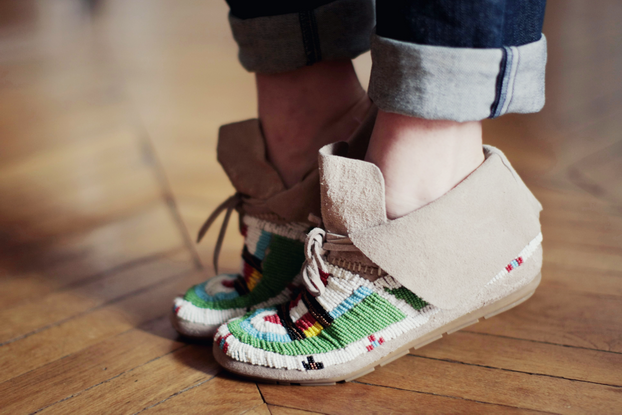

These slippers/moccasins were in the same section, and came in brown and red as well. I saw them as a take on Alaska Native mukluks, though the use of geometric diamonds is a bit southwest/plains.


Finally, down in the bargain basement, I found this "totem pole jewelry stand." You can see they weren't huge sellers.

I got home and tried to look up these three on their website, to get product names, etc. and had no luck, but did manage to find a few other examples online:

The Booty Buddy Blanket The comments section refers to it as "the hipster snuggie."

Tribal V Neck

Leather Navaho cuff: there is a lot to say about this one, not least of which is the antiquated spelling of Navajo and the plains-style beading.

even more examples: Native Socks, Cement Chief Necklace (yes that is a tiny headdress), and Geo Beaded Cuff. There are more, if you go to their website and just search "Native" or "Tribal."