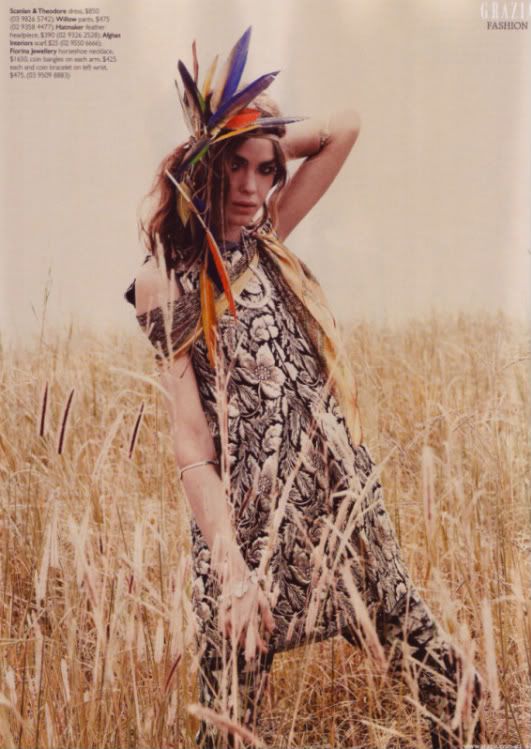
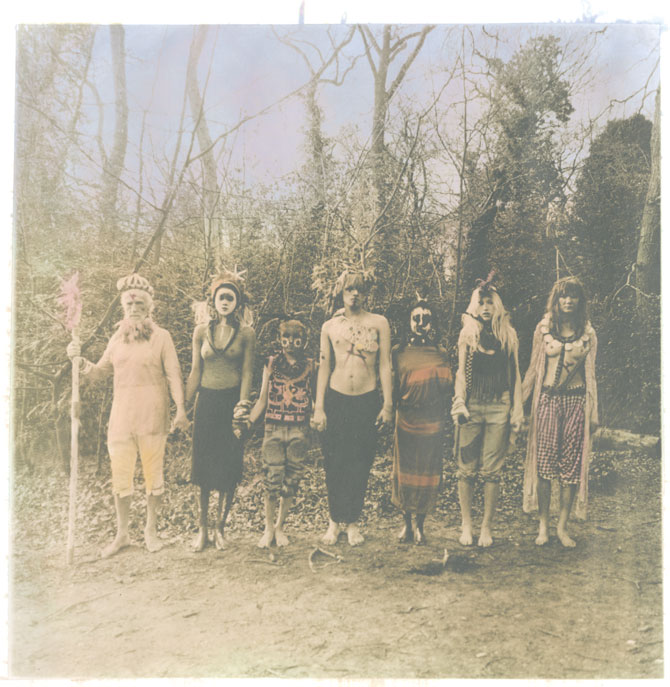
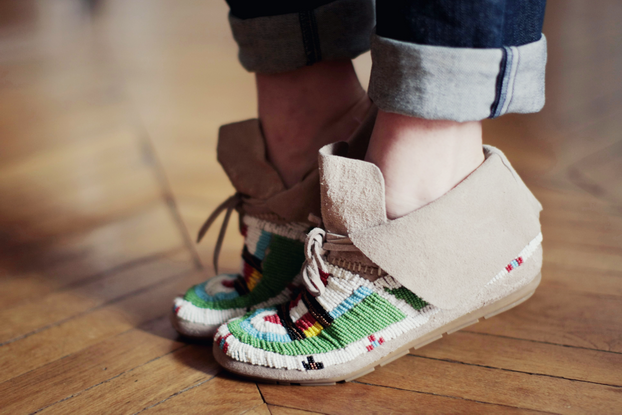
Showing posts with label tribal fashion. Show all posts

Friday, October 7, 2011

Anthropologie "Haida Poncho"--is Haida the new Navajo?

A couple of weeks ago, I drew attention to how obsessed Urban Outfitters is with the term "Navajo" to represent a catch-all stereotypical southwest/plains asthetic. Then this week, reader Julia sent me a link to the Anthropologie website, with several "Native" inspired pieces. The one that caught my eye was the "Haida Poncho," shown above.

I just thought it was interesting, given we recently discussed Miss Canada's horrific "Homage to Haida," that Haida keeps popping up, rather than the typical Navajo or Cherokee.

First of all, this poncho is made by Pendleton, but is part of their "Portland Collection"--the hipster cool line that I've written about before. I went to both the Pendleton site and the Portland Collection site, and couldn't find anything with the name "Haida."


After the Urban post, a few readers pointed out to me that the products were not named "Navajo" on the original brands' sites, meaning Urban had added the name on later.  Pendleton is generally pretty accurate with their descriptions, linking them to the correct tribe or community where the design originated, so I was surprised that they would call this southwest mess a "Haida" poncho. It makes sense that it may have been a branding choice by Anthro.

Oh, did I mention Anthro and Urban (as well as Free People) are all under the same parent company? Cause they are. Surprise, surprise.

So, if you were wondering what a Haida poncho would look like, here's an example, made by the incredible Dorthy Grant, a Haida designer:


A little different, right? Here is where we pause and talk about how harmful this is to smash completely different cultural groups into one stereotyped "Native American Design." This erases out existence as  diverse, living, and contemporary communities, and furthers the stereotype that there is only one type of "Indian"--the plains warrior that died out long long ago.

But you know what I thought of instantly when I saw the poncho? Wednesday Addams in the Thanksgiving Pageant:

Side-by-side comparison?


Look, I made Wednesday a new outfit!


UPDATE 10/11: A commenter pointed out that the website has changed the name from "Haida Poncho" to "Ashcreek Poncho"! Though some other third party sites are still calling it "Haida." A definite step in the right direction, and pretty awesome if we had anything to do with it!

Links:
Anthropologie "Haida Poncho" (only $248!)
Dorothy Grant, Haida designer

Earlier:
Oh, (Miss) Canada
Urban Outfitters is Obsessed with Navajos
Let's Talk About Pendleton

(Thanks Julia!)

Friday, September 23, 2011

Urban Outfitters is Obsessed with Navajos


A search for "Cherokee" on the Urban Outfitters website reveals 1 result. A search for "Tribal": 15. A search for "Native": 10. "Indian": 2. But Navajo? 24 products have Navajo in the name alone.

This post started as a massive Urban Outfitters take-down, I spent an hour or so last week scrolling through the pages of the website, and adding anything to my cart that was "Native inspired" or had a tribal name in the description. I got through JUST the women's clothes and accessories (no mens or apartment), and had 58 items in my cart. So, then, like any good researcher, I began to code my cart for emergent themes, and the one that jumped out far above the rest? Urban Outfitters is obsessed with Navajos.

I want to show you some examples, and then talk a little about the issues with using tribal names in products that are decidedly not-<insert whatever tribal name here>. Finally, I want to share what the Navajo Nation in particular is doing about it, and the action they've taken is pretty cool.

Without further ado, some of the "Navajo" products to grace the pages of Urban:

From the basic:


To the totally random:

The Antiquated:

And, finally, the totally offensive:


Of course, there are many more if you head over to the site and search "Navajo".

So what's inherently wrong with using Navajo in product names? And what can tribal nations do about it?

First of all, these products represent a stereotype of "southwest" Native cultures. The designs are loosely based on Navajo rug designs (maybe?) or Pendleton designs, but aren't representations that are chosen by the tribe or truly representative of Navajo culture. Associating a sovereign Nation of hundreds of thousands of people witl a flask or women's underwear isn't exactly honoring. 

Additionally, it's more than likely that Urban chose "Navajo" for the international recognition--to most of the world Navajo (and Cherokee)= American Indian  (my Jamaican friend didn't even know there were other tribes in the US until she met me). This conflation of Navajo with "generic Indian" contributes to the further erasure of the distinct tribes and cultures in the US and solidifies the idea that there is only one "Native" culture, represented by plains feathers and southwest designs.

Navajo has taken a bold step, and actually holds trademarks for 12 derivatives of "Navajo", three of which I'm citing below:
 2061748: NAVAJO Sportswear; namely, slacks, shorts, skirts and jeans.

2237848: NAVAJO Clothing; namely, tops, vests, shirts, sport shorts, polo shirts, golf shirts, * jackets, * T-shirts and sweat shirts.

3602907: NAVAJO  Online retail store services; namely, on-line ordering services in the field of clothing—specifically, men's and women's sportswear, namely, jeans, tops, shirts, sport shorts, polo shirts, golf shirts, T-shirts and sweatshirts.
I'm no law expert, but it feels like the products above might be violating the trademarks? 

A few months ago, they Navajo Nation Attorney General actually sent a cease and desist letter to Urban Outfitters, and there are some great quotes from the letter (I'll try and post it in full in another post):
Your corporation’s use of Navajo will cause confusion inthe market and society concerning the source or origin of your corporation’sproducts. Consumers will incorrectly believe that the Nation has licensed,approved, or authorized your corporation’s use of the Navajo name andtrademarks for its products - when the Nation has not - or that yourcorporation’s use of Navajo is an extension of the Nation’s family oftrademarks - which it is not.  Thisis bound to cause confusion, mistake, or deception with respect to the sourceor origin of your goods. This undermines thecharacter and uniqueness of the Nation’s long-standing distinctive Navajo nameand trademarks, which—because of its false connection with the Nation—dilutesand tarnishes the name and trademarks. Accordingly, please immediately cease and desist using the Navajo nameand trademark with your products. 
As a Nation with a distinguished legacy and unmistakablecontemporary presence, the Nation is committed to retaining this distinctionand preventing inaccuracy and confusion in society and the market  The Nation must maintaindistinctiveness and clarity of valid association with its government, itsinstitutions, its entities, its people, and their products in commerce.When an entityattempts to falsely associate its products with the Nation and its products,the Nation does not regard this as benign or trivial.  TheNationremains firmly committed to the cancellation of all marks that attempt tofalsely associate with the institution, its entities, its people or itsproducts. Accordingly, immediately cease and desist using Navajo withyour products.
I haven't heard what the response was from Urban, if any, but I think it is a bold and positive choice for the tribe to take matters into their own hands and push back on instances of misrepresentation and cultural appropriation.

What do you think? Should tribes go the route of Navajo and trademark their tribal names? Do you think this will be an avenue for positive change or just mean tribal courts will be mired in lawsuits, taking away time from other important tribal business?

(Thanks Marj, Brian, and Aza!)

Saturday, July 9, 2011

Oh Spirit Hoods.


Oh Spirit Hoods. One of those fashion trends that makes me pause, cock my head, and say "really??" If you're unfamiliar (meaning you're not one of the 15,000+ people who "like" the brand on facebook), Spirit Hoods are furry animal hat/scarf combos that are all the rage with tweens, celebs, and hipsters alike. I've gotten a few tips recently about the company, particularly their use of the tag-line "join the tribe":


http://spirithoods.com/about-2/
At first, I was annoyed by the tag line, but found the whole concept of wearing an disembodied stuffed animal on your head so ridiculous, figured it wasn't worth the fight. They also don't focus solely on what I would call the stereotypical mystical, Native animals (wolves, bears, deer, buffalo, owls, etc), they have pandas, leopards, and lions as well. But then, I started exploring their site further, and I got a tip about their new "Navajo wolves" line. And boy did I change my mind.
 

The "Navajo Wolves" collection are the wolf hoods, lined in Pendleton-style fabric.

For each "animal" they provide a description of what the "animal spirit" represents--traits and characteristics that the wearer will somehow embody. And the accompanying description for the "Navajo Black Wolf" is just fantastic:
Black Wolf-Navajo
Mysterious » Shapeshifter » Beauty
The black Wolf spirit has unmatched ferocity, cunning, stealth, confidence, and loyalty. They howl at the moon and are great communicators with a strong appreciation of music. This animal spirit feels at home within order and chaos. Often a teacher or dancer with keen senses, these warrior spirits will also defend their ground. The Black Wolf is in touch with lunar influences and the shadow within. This healer brings the magical spirit-medicine.

Deep breath. Ready? Let's looks at this critically. How many stereotypical "Indian" traits can we fit into a short paragraph? So apparently Navajos are described by the terms "mysterious, shapeshifter, beauty"--because we're all like twilight and turn into wolves. Though, it's an interesting reference to skinwalkers too (f you want to be scared s***less, have a Navajo tell you some of those stories. ::shudder::). Then we've got the "warrior spirit" and "brings the magical spirit-medicine"--basically every line of this description reads like a bad Indian fantasy novel. We've got the warrior stereotype, the connected with nature and the environment stereotype, the wise teacher stereotype, the mystical healer stereotype, the musical stereotype...on and on and on. "But," you may be saying, "it's about a wolf, not an Indian, you silly blogger-woman!" I think it's fairly obvious the connection they're trying to make with the Pendleton fabric and calling the darn thing a "NAVAJO" wolf.

So, a few brave Native Approps readers took the issue head-on over at "Kingdom of Style". Look for the comments by "Mea." The fascinating part comes from a comment by the Co-Founder of Spirit Hoods--this is the philosophy of the company, straight from the horse's mouth. Another deep breath may be necessary, and try to read past all of the misspellings and grammar errors:
This is a good topic for discussion, and in fact we at SpiritHoods have taken a lot into consideration when it comes to Native American culture. In no way are we trying to demean or prostitute Native American's, in fact their way of life has been so inspiring to us that it has forced us to evaluate our lives and everything we do within it. For instance us four owners went to a traditional native American sweat lodge out here in California together. If anything we are inspired by native culture and their respect for the land and it's animals, but not just Native American's, native's all over the world.
The animal headdress is seen in many cultures, Alaskan natives, American natives, South American natives, African natives etc. The Spirit of the animal and our connection to it is seen in cultures all over the world and we believe it is innate within us. Hence the importance of Product Blue and why we give back to non-profits that help in the rehabilitation of these animals.
Native American's see this duality and the importance of our co-existence and protecting it. If anything we are trying to help perpetuate that.
We try our very best to respect all people and cultures in everything we do, we are inspired by their designs, their philosophies and what we want to do with SpiritHoods is embrace self expression with a foundation of giving back.
If your interested in more about this topic here is a good read:

http://thesocietypages.org/socimages/2010/04/13/american-indian-is-in/
and check out out http://www.spirithoods.com/problue/ to learn more about how we support the animals
Alexander Mendeluk

CO-Founder/Director of Design&PRSpiritHoods www.spirithoods.com/problue
Wow, thank you, Alexander for telling all of us what exactly Native Americans (all of the millions of us) think! and thank you for realizing that there is only one "Native American culture" and that we are all exactly the same! and thank you  for finding our way of life (since we only have one!) "inspiring"--since marginalization, colonization, and ongoing poverty are awesome, right? and thank you for going to a "traditional Native American sweat lodge" so you now have the first-hand experience and knowledge to speak for all of us! and finally, thank you for considering the animals first. I'm glad to know your "foundation of giving back" doesn't extend to the people that your product is so clearly "inspired by"--that would be silly!

Dripping sarcasm aside, I love the irony of him linking the SocImages post that's a summary of my blog. Talk about missing the point.

Honestly though, it's a hard line, because clearly Alexander and Spirit Hoods don't think they're being offensive. They truly believe that going to a "traditional Native American sweat lodge" is enough to force them "to evaluate our lives and everything we do within it," they truly think they are showing respect to Native peoples and cultures. 


So how do we go about addressing something as deep as this? That's a struggle I have with many of these examples--if the owners read this, they are going to get defensive and dismissive, and not actually think deeply about what effects their actions are having on the collective American consciousness about Native peoples. Especially when their products are making them hella cash (each retails for $150) and are all the rage--what motivation do they have to change? So if we can't change the company, let's change from the ground up: Don't buy from Spirit Hoods, because they promote the stereotyping of Native peoples, the appropriation of our tribal names and traditions, encourage the problematic practice of "playing Indian", and the company philosophy is based off of a harmful romanticized vision of Native cultures. 

Spirit Hoods Official Website: http://spirithoods.com/
Kingdom of Style: The Night Owl


(Thanks Jackie, DC, Christi, Alyss, and the others who sent this in!)

Friday, July 8, 2011

The Today Show thinks "Tribal Jewelry" is a "Summer Outfit Maker!"

 Right on the heels of our great discussion on Al Jazeera's The Stream, the Today Show decided to feature "tribal jewelry" as one of its go-to summer "outfit makers." I'll embed the video clip below, but I don't know how long it'll be up on the site, so I took some screen shots and made a quick transcript as well:


 Text of their conversation (more or less...they should learn to listen while someone else is speaking!) is below:

"Our next trend is that all that tribal look has morphed into more of an American Indian vibe. And this is a look that is in summer, we see it a lot in summer..." (Kathy interrupts)

"well you always see this out there in Arizona and those western states..."

"true,true,  but this is actually something that is carrying into Fall. We saw it on the runway. This necklace is from Lauren Wells, it's inspiration, it's 96 dollars, but I promise you this with a white t shirt and jeans is a great go to summer look. it's a really strong look, and these are from express, these earrings here are good if you just want to try the trend."

"So is the feather thing still going to last?"

"Well yes, I think so, it's that Hollywood-Coachella festival kind of vibe..."
Here's the Lauren Wells Necklace:

and the Express earrings:

So, basically this one minute clip is demonstrating a lot of the points I try to get across with this trend. The use of generic "tribal" to represent some random stereotype of "Indigenous"--or even the term "American Indian vibe"--Honestly, what does that even mean? And which American Indians are you talking about?

Then, the fact that all of the pieces are shoddy knock offs of Indian artisan work--Lauren Wells seems to be a designer that takes a LOT of "inspiration" from Native designs, and those express earrings look just like ones you could buy at any powwow from, you know, a real Native artist. What a novel concept.

Finally, the "feather trend" which Kathy (or Hoda, I can't tell, they're all talking at once) says she's "sick of" and that people should "go to Las Vegas" where they'll see "plenty of feathers." The "feather trends" are based off of Native practices of wearing feathers as part of regalia or traditional clothing, and their comments are reducing a sacred practice (feathers in many communities are given as part of special ceremonies, or in honor of large accomplishments) into a trend that you can be "sick of" or akin to a showgirl's headdress in Vegas. Exactly the same thing, right?

The last point about the feathers is part of a larger issue I've been grappling with--while I look forward to the day that I no longer see Native cultures mis-represented in store windows, the whole process of "discarding" the trend as "over" or "so last year" by default makes Native peoples and cultures disposable as well. The dominant culture can take what they want, use it as they see fit, and then ultimately throw it away.

So in one minute, the Today Show manages to condense millions of Native people into a single, incorrect, otherizing stereotype, encourage viewers to buy Native style jewelery from non-Natives, and minimize an important and sacred cultural marker of many tribes. Bet the producers didn't think about all that.

Today Show: Summer Outfit Makers
(Thanks Myrton!)

Thursday, February 3, 2011

Let's Talk About Pendleton

(look from Pendleton's new "Portland Collection" for Fall 2011. Source here.)

Last night I was cold. So cold, in fact, that I had to pull out not one, but two, of my Pendleton blankets to add some extra warmth to my bed. As I shook them out and laid them on my bed, I thought about how special these blankets are to me--one was a graduation gift, the other a thank you gift for serving on a panel about the "Future of Indian Education." In many Native communities, Pendleton blankets are associated with important events, and have been for hundreds of years. They are given as gifts at graduations, at powwow give-aways, as thank you gifts, in commemoration of births and deaths, you name it. In addition, I've always associated the patterns with Native pride--a way for Natives to showcase their heritage in their home decor, coats, purses, etc. There's something just distinctly Native about Pendleton to me.

(Stanford Native Graduation from a couple years ago)

But recently, Pendleton prints and fabrics have started popping up everywhere. It started with Opening Ceremony's Pendleton line in 2010, and now Urban Outfitters has started carrying a Pendelton line, celebrities are wearing Pendleton coats, and Native-themed home decor is apparently all the rage. Now Pendleton has announced their newest collaboration, The Portland Collection, which fashion blogs are proclaiming will be the big thing for 2011.


So what's the problem? I openly admit that a lot of these designs are adorable, and I would fully sport them (that bag! I love!), if I had a spare $1000 or so. I can't cry straight up cultural appropriation, because...well, it's complicated.

Pendelton has been supplying Natives with blankets and robes with Indian designs since the late 1800's, which the "history" section of their website outlines:
A study of the color and design preferences of local and Southwest Native Americans resulted in vivid colors and intricate patterns. Trade expanded from the Nez Perce nation near Pendleton to the Navajo, Hopi and Zuni nations. These Pendleton blankets were used as basic wearing apparel and as a standard of value for trading and credit among Native Americans. The blankets also became prized for ceremonial use.
It's almost a symbiotic relationship--they saw a market in Native communities, and Native communities stepped up and bought, traded, and sold the blankets, incorporating them into "traditional" cultural activities. Pendleton has also maintained close ties with Native communities and causes, making commemorative blankets for organizations like the National Museum of the American Indian and the National Indian Education Association. They work with Native artists to design the special edition blankets, and even donate some of the proceeds to the causes.

 (NIEA 40th anniversary blanket)

But then, on the other hand, they go off and do things like design a $5000 blanket with White Buffalo hair, which many tribes consider extremely sacred and definitely off-limits to commercial sale.

I do appreciate Pendleton's relationship with Native communities. I love my blankets, and love even more what they represent.
 
However, seeing hipsters march down the street in Pendleton clothes, seeing these bloggers ooh and ahh over how "cute" these designs are, and seeing non-Native models all wrapped up in Pendleton blankets makes me upset. It's a complicated feeling, because I feel ownership over these designs as a Native person, but on a rational level I realize that they aren't necessarily ours to claim. To me, it just feels like one more thing non-Natives can take from us--like our land, our moccasins, our headdresses, our beading, our religions, our names, our cultures weren't enough? you gotta go and take Pendleton designs too?

 (source)
Then there's the whole economic stratification issue of it too, these designs are expensive. The new Portland collection ranges from $48 for a tie to over $700 for a coat, the Opening Ceremony collection was equally, if not more, costly. It almost feels like rubbing salt in the wound, when poverty is rampant in many Native communities, to say "oh we designed this collection based on your culture, but you can't even afford it!"

So I don't know. Are all of these designs cultural appropriation? Should I ignore the twinge in my stomach every time I see a Pendleton pattern in the Urban Outfitters window? Should I embrace it as the mainstream fashion scene finally catching up with what we Natives have known since the 1800's?

Personally, the bottom line is that I would rather associate Pendleton with Native pride and commemorating important events...

(our panel last year)

...than with hipsters, high fashion, and flash-in-the-pan trends. But I'm obviously conflicted. What do you think? Are these designs and trends ok, or do I have a right to be upset?

(Thanks to Precious for getting me thinking about this!)

Tuesday, October 5, 2010

Project Runway's "Squash Blossom" blouse


I've been reading a few Project Runway recaps and watching some sporadic clips online (again with the no cable thing--you think I can get cable written off as a blogging expense?), and a couple of people sent me this image from last week's episode.

From what I can gather, the contestants were asked to create a textile design, and then make an outfit centered around their creation. Gretchen chose the design above, which she called a "squash blossom" design, as a nod to her upbringing in the southwest.


So, it's actually kinda pretty. I like it. But, it's not a squash blossom design. This is a squash blossom design (or at least what I've always seen referred to as a Navajo squash blossom necklace):

(awesome picture, right? it's from Life Mag's archives, here)

Gretchen's design is, to me anyway, a Zuni headdress/sunbonnet design:


I think this brings up a really interesting discussion. I think it is ok for designers to "draw inspiration" from Native cultures, but it can become very uncomfortable very quickly, and there is a fine line between what is acceptable and what could be considered otherizing, marginalizing, and cultural appropriation.

As it stands, Gretchen collapsed many distinct tribes throughout the southwest region into one "Southwest Native American Style", and mis-characterized the design as a "squash blossom". She didn't attach an actual tribe to the design, which a quick google would have solved real quickly.

But also, like I said, I didn't see the episode, so let me know if I'm giving her an unreasonably hard time.

So, if Gretchen had said "my design is a design taken from the Zuni Pueblo in New Mexico, it is a traditional headdress or sun bonnet design, and is often used on jewelry pieces by pueblo artisans..." or something of the sort, would it have been better? I'm not sure.

Where do we draw the line of inspiration and appropriation? Can "inspiration" be done in a way that is positive for the (almost always) marginalized communities that the designs or styles are taken from?

These are things I grapple with all the time as images come through my inbox...and I'm still not sure I have an easy answer.

Thoughts?

UPDATE: apparently Gretchen DID call it a "sunbonnet" design, and the "squash blossom" came from the bloggers who apparently don't pay attention to the actual episode they are recapping. From my friend A.:
"Although I don't pretend to speak for the propriety of Gretchen's use of the sun bonnet pattern, I watched the episode, and she did say she was inspired by her mom's sun bonnet jewelry (not squash blossom), with multiple references to having grown up "in the southwest." The whole episode is available for viewing on mylifetime.com (it was an awesome episode, although not because of Gretchen)."
 So thanks for filling me in!

(Thanks Maria!)

Friday, August 27, 2010

"Navajo" Fashion Spread in Seventeen

(via my culture is not a trend, click for bigger version)
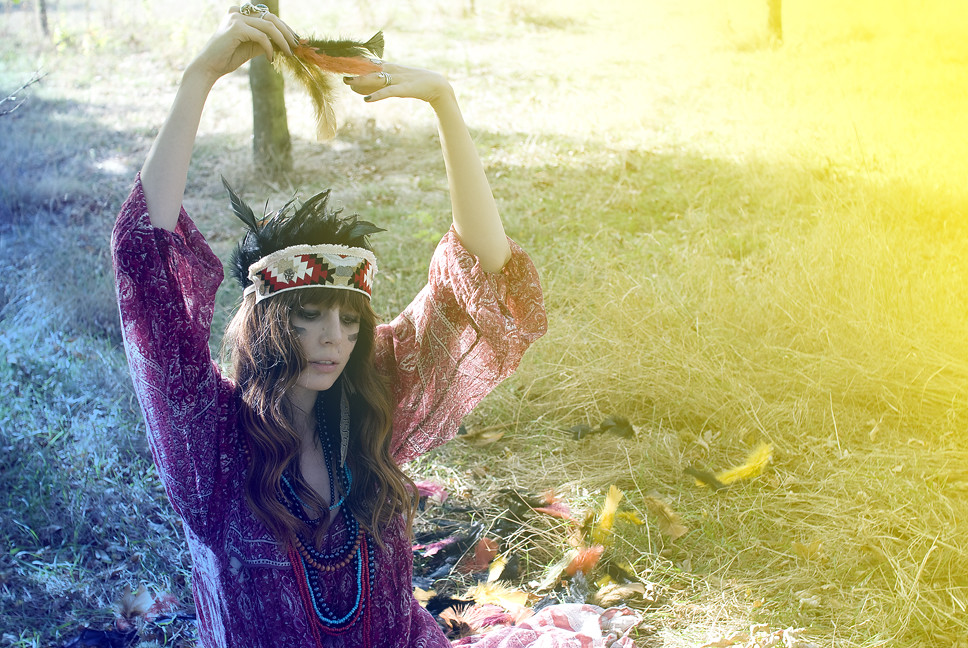
Cultural appropriation in fashion has now gone seriously mainstream. The favorite read of tweens and teens everywhere, Seventeen Magazine, featured this "Navajo" fall fashion spread in their August issue. On many levels, I find this even more offensive than having a generic "tribal fashion" spread. I know I always point out that those spreads lump a million different Native tribes, images, and traditions into one catch-all, otherizing, "tribal" idea--and at least this one listed a tribe, right? Yeah, not so much. 


They still rely on generalized Native stereotypes, but this time are referring to a specific culture. This points to the fact that in the collective American consciousness, all tribes are interchangeable. Navajo, Ojibwe, Kootenai, take your pick. They're all the same! For instance, dream catchers: definitely not Navajo. Would I still be upset if they had paid attention and made taken inspiration from actual Navajo culture? Like if they had a white model dressed up in a rug dress? Of course. But hopefully you see my point.

My friend Marlon did a little research, and found out that in January 1973 Seventeen actually did a cover story entitled: "Special Report: Today's Young Navajos". I love the cover image (below) for many reasons, but mainly because they didn't have her pose in traditional clothes or try and have her conform to a more stereotypical image. She looks like she's about to laugh, just hanging out with her friends. Well done. I can't find the article, so I have no idea if the accompanying story was a shining example or a cringe-inducing piece, but it's still pretty interesting to examine the cover alone: 
 

As I was pulling together this post, I wanted a shocking, over-the-top example to illustrate how these fashion spreads make me feel every time I encounter them in magazines or on other fashion blogs...so I turned to polyvore and MS Paint, and made this:

UPDATE 8/28: After sleeping on it, I took it down. What was here was a "fashion" spread made up of various Africa/Urban/other Black stereotype "inspirations". It didn't illustrate my point, and any point it did make was at the expense of another marginalized group with not nearly enough context or description given. I was going for a visceral reaction, but in a blogging world where most page views are a matter of seconds, it's definitely not enough to throw that up there alone. I also want you to focus on the juxtaposition of the two Seventeen images rather than my misguided attempts at making a point. Apologies for my initial transgressions, and in the words of Kanye West's prolific Twitter: IT'S A PROCESS.  Thanks for bearing with me.  

I bet every fashion blogger making an Native-inspired version relies on the same tatic--pulling together complete stereotypes of what they think of when they hear "Native American". We are so much more than that--but to the readers of the August issue of Seventeen and the fashion blogosphere, we are simply feathers, dream catchers, headdresses, warpaint, moccasins, and beads. Nothing more. 


(Thanks Lauren and Marlon!)


Thursday, June 3, 2010

The Ultimate Tribal Fashion Roundup (June 2010 version)


It's been a while since my last tribal fashion roundup back in March, and even longer since I first questioned the emergence of Native themes in fashion back in January. The trends don't seem to be slowing down, and if the prevalence of the hipster headdress is any indication, they might be sticking around for even longer. So there may be an Ultimate Tribal Fashion Roundup July, and August, and September...we'll have to wait and see.

Just to get it out of the way early in the post, or in case you need a refresher, here's why all this is not cool: But Why Can't I Wear a Hipster Headdress?  The Last point is particularly relevant here, so I'll repost:

Well then, Miss Cultural Appropriation Police, what CAN I wear?
  • If you choose to wear something Native, buy it from a Native. There are federal laws that protect Native artists and craftspeople who make genuine jewelry, art, etc. (see info here about The Indian Arts and Crafts Act). Anything you buy should have a label that says "Indian made" or "Native made". Talk to the artist. Find out where they're from. Be diligent. Don't go out in a full "costume". It's ok to have on some beaded earrings or a turquoise ring, but don't march down the street wearing a feather, with loaded on jewelry, and a ribbon shirt. Ask yourself: if you ran into a Native person, would you feel embarrassed or feel the need to justify yourself? As commenter Bree pointed out, it's ok to own a shirt with kimono sleeves, but you wouldn't go out wearing full kabuki makeup to a bar. Just take a minute to question your sartorial choices before you go out.  
These images are gathered from all walks of fashion and the far corners of the internets. Beneath each photo I've put the source and any other pertinent information. Most of the links have many more photos, but I just picked one or two for you to get the gist of it, so click through for more. Ready? Here we go...


DIY headdress from Bleach Black...it's still not ok even if you make it yourself. sorry. 


American Apparel Look Book

"Dead Man" inspired shoot
(That's that movie with Johnny Depp, right? so they're not calling Natives dead?)

It's invaded accessories too:


(And I had posted this other Hermes Scarf earlier)


Spool 72., which I've also posted about earlier, has even more bags made out of "vintage Native American rugs" on their site now


Kitson e-mail newsletter--Buyers Picks: Tribal Accessories


Window displays at Juicy Couture Manhattan (they had the same ones in SF too)

Headdress T-shirt at Blush in Manhattan

Urban Outfitters "Obey Navajo" Shirt

There are so many more, but hopefully this gives a good overview of some of the stuff out there. I'll try and do some of these roundups a little more often throughout the summer, and as always, continue to send things to me as you see them. 

I've realized this post is sadly devoid of snarky commentary! I'll make up for it in the next one, promise. 

(Thanks to Lici, Tasha, Jesse, Natalie, Katie, Sarah, Mollie, Tanis, Consuelo, Lisa, and anyone else I missed!)